For whom Teams moving Figma Variables into frontend code
Scope Plugin · CSS Custom Properties · Tailwind
Tools Figma Variables / CSS Custom Properties / Tailwind
The idea
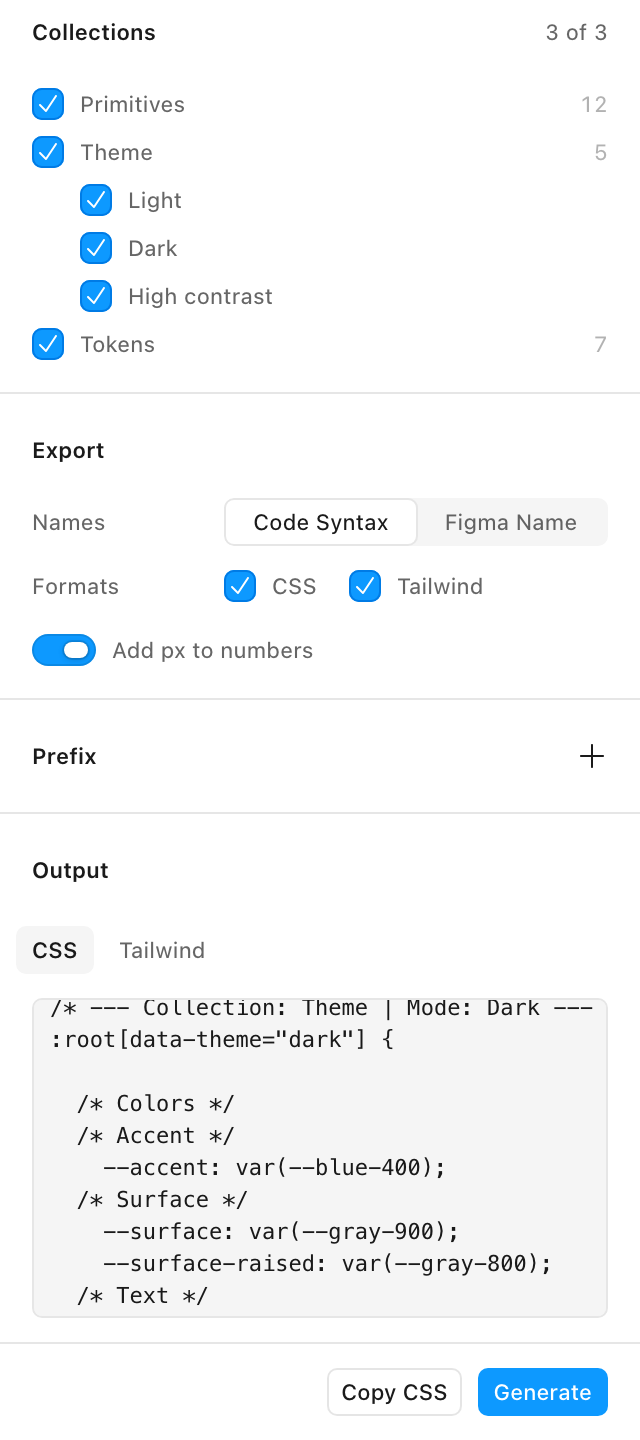
Bring tokens into code, with their themes and references intact. When moving Figma variables into code, I wanted to preserve their collections, modes, and relationships. I developed Tokens to Code to generate CSS and Tailwind configuration from that structure, with control over naming and an output that can be reviewed before integration.
Design considerations Preserve modes and cross-variable references. Give users control over names, units, and selection. Warn when references cannot be resolved. View the source Modes
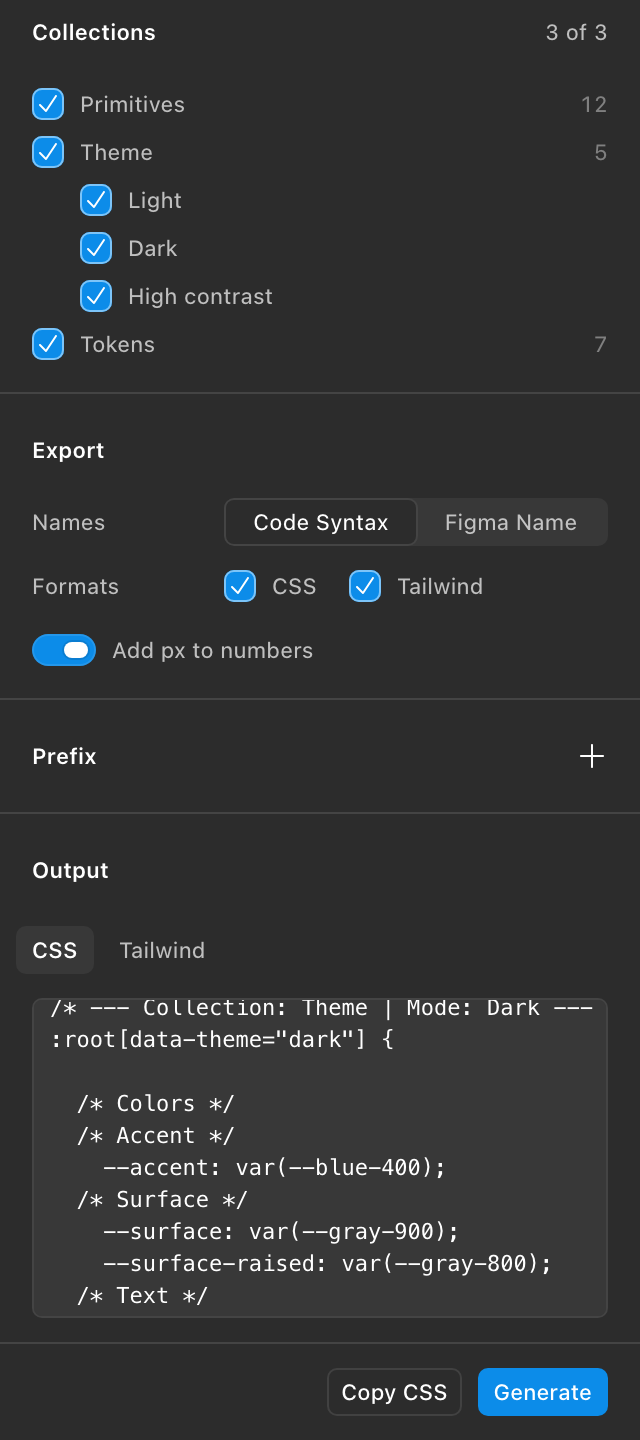
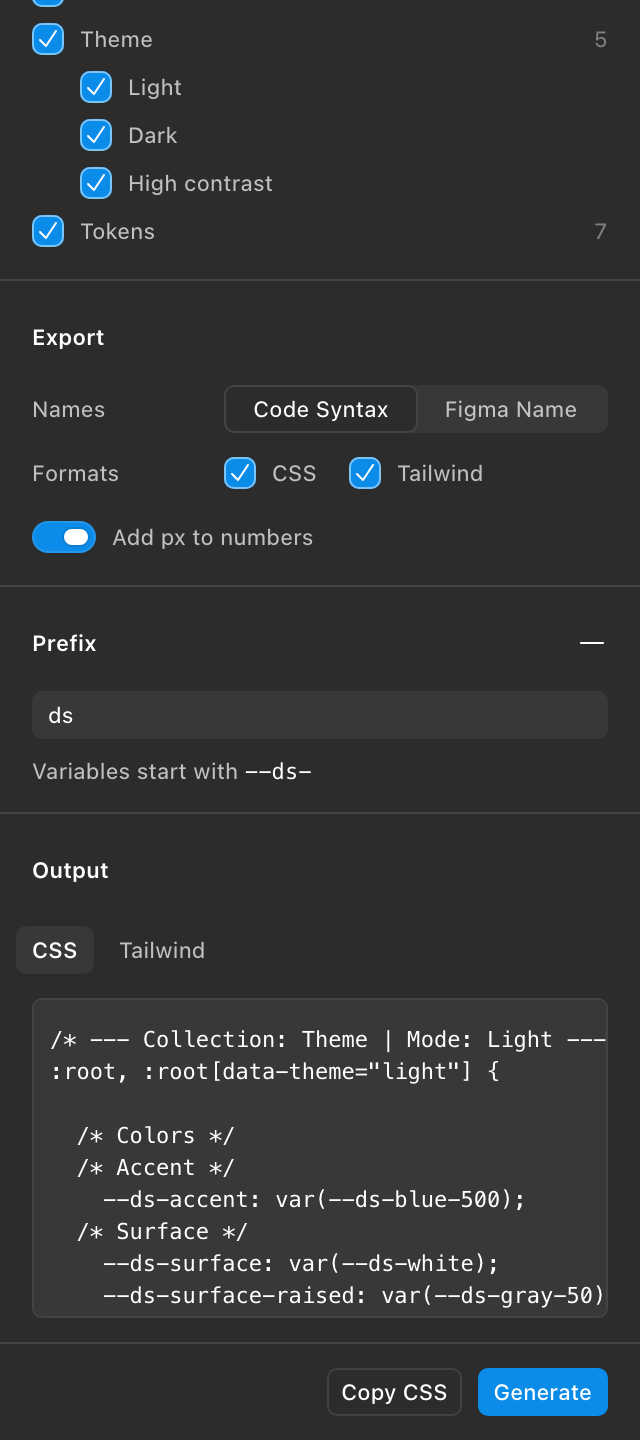
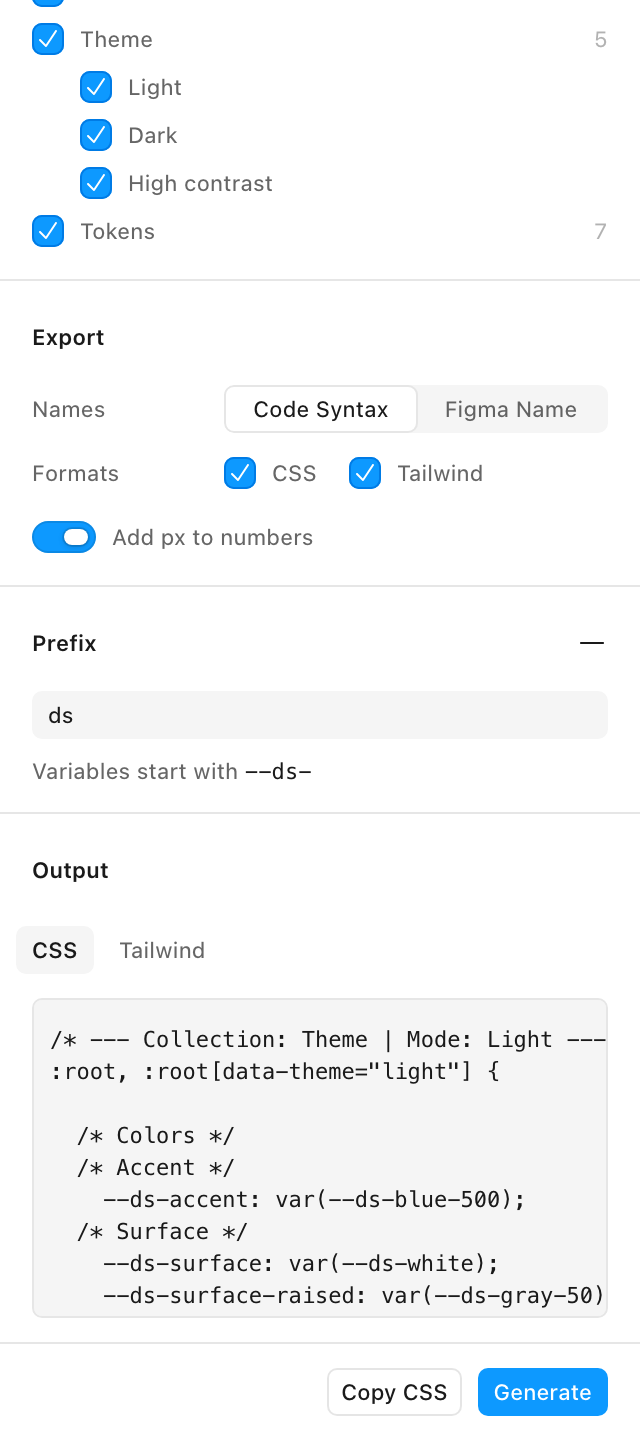
Preserve modes in CSS. I generated one block per mode with :root[data-theme]. The default mode is written to :root, and aliases stay as var() references.
Release notes Version 2.0 · 3 min read
Read :root, :root[data-theme="light"] {
--accent : var(--blue-500 );
--surface : var(--white );
--surface-raised : var(--gray-50 );
--text-primary : var(--gray-900 );
--text-secondary : var(--gray-500 );
}Release notes Version 2.0 · 3 min read
Read :root[data-theme="dark"] {
--accent : var(--blue-400 );
--surface : var(--gray-900 );
--surface-raised : var(--gray-800 );
--text-primary : var(--gray-50 );
--text-secondary : var(--gray-400 );
}Release notes Version 2.0 · 3 min read
Read :root[data-theme="high-contrast"] {
--accent : var(--blue-700 );
--surface : var(--white );
--surface-raised : var(--white );
--text-primary : var(--black );
--text-secondary : var(--gray-900 );
}Selection
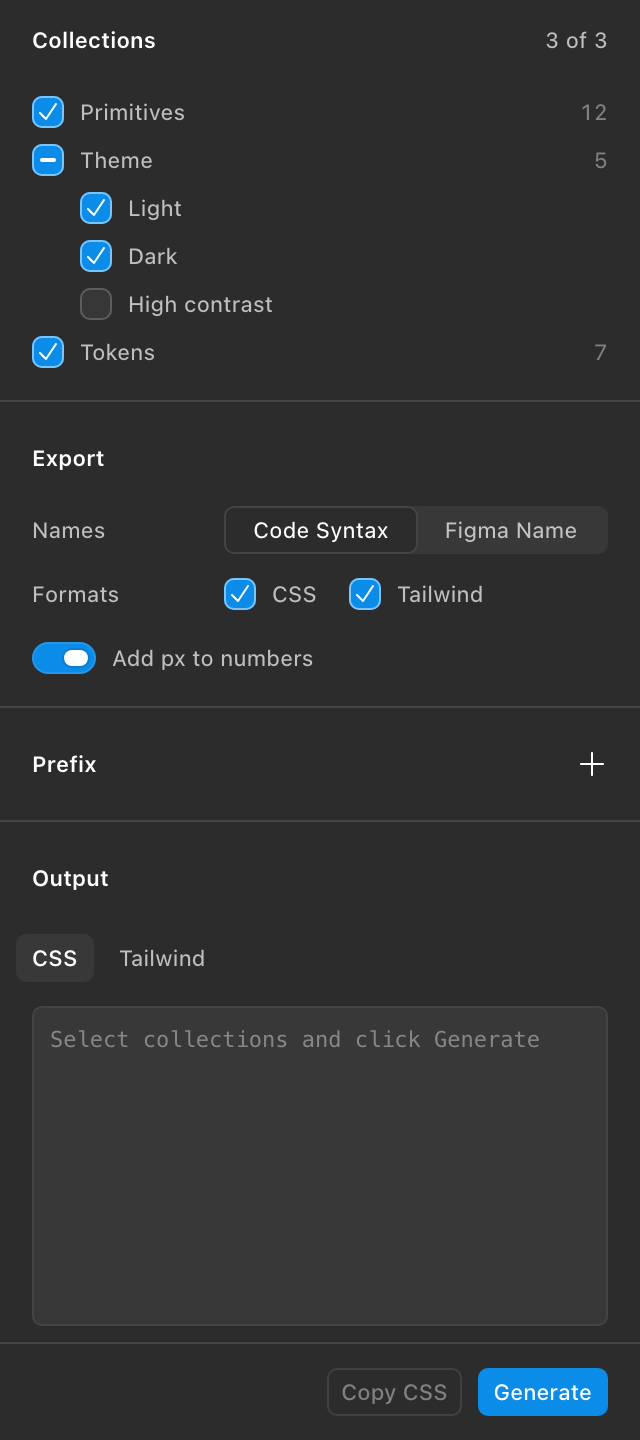
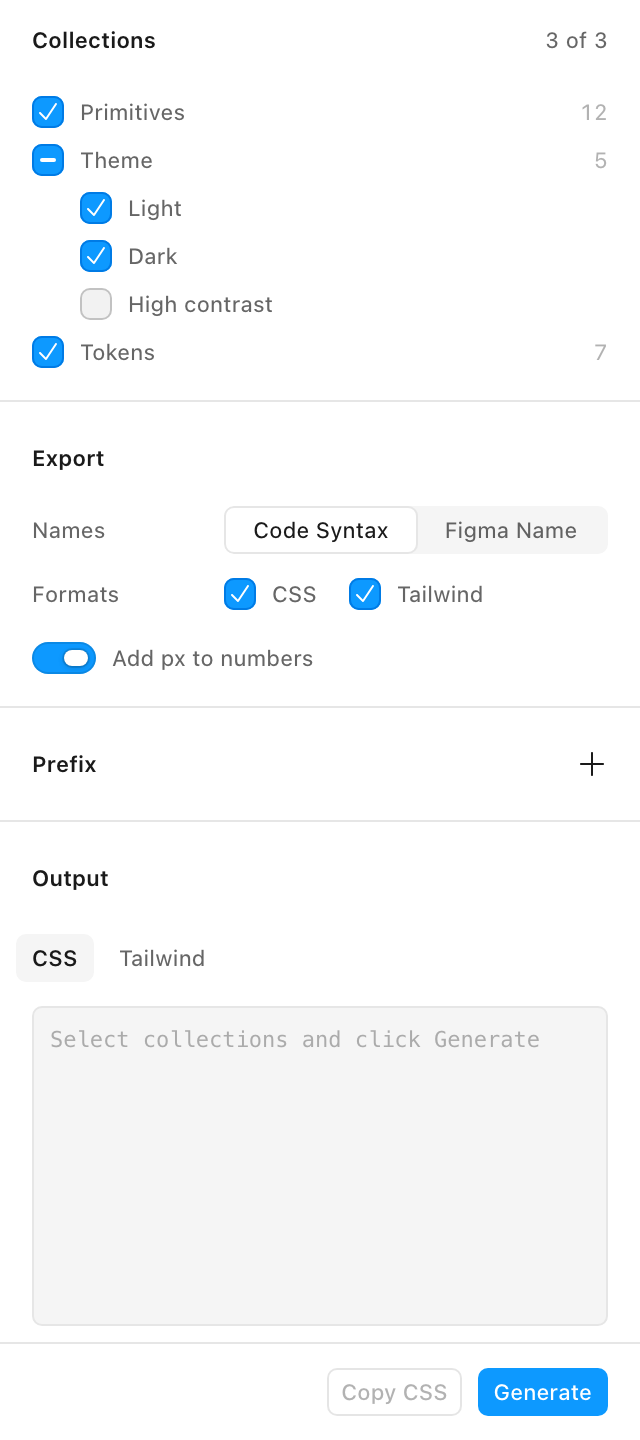
Control the export scope. I let users choose collections, modes, and formats, including web Code Syntax or Figma names. Exporting does not alter source variables.
Aliases
Preserve token references. I kept semantic-to-primitive references through var(). External aliases are resolved to values with a comment identifying their origin.
text/primary → --text-primary : var(--gray-900 );
accent → --accent : var(--blue-500 );
brand/legacy Team library → --brand-legacy : 255 69 58 ; /* alias: Brand/Coral */
Tailwind
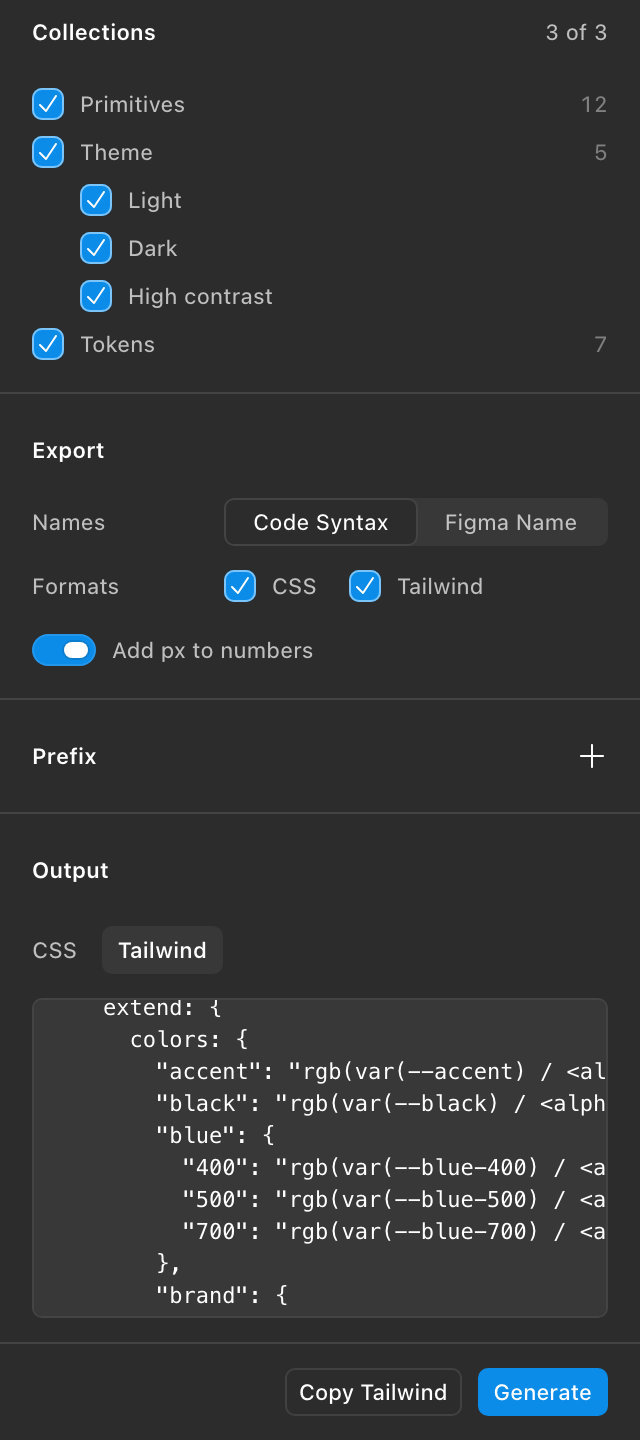
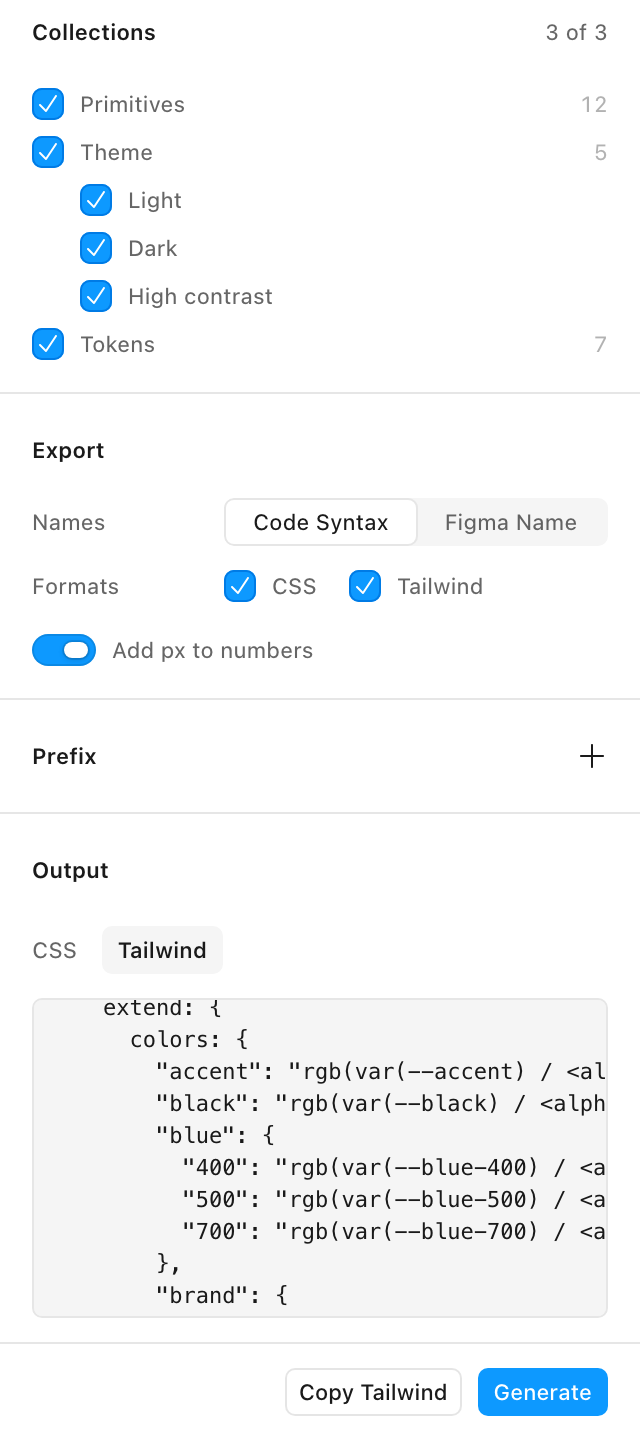
Connect Tailwind to CSS variables. I made Tailwind configuration reference CSS custom properties to preserve theme switching and opacity modifiers.
tailwind.config.js theme: {
extend: {
colors: {
"accent" : "rgb(var(--accent) / <alpha-value>)" ,
"surface" : {
"DEFAULT" : "rgb(var(--surface) / <alpha-value>)" ,
"raised" : "rgb(var(--surface-raised) / <alpha-value>)"
},
"text" : {
"primary" : "rgb(var(--text-primary) / <alpha-value>)" ,
"secondary" : "rgb(var(--text-secondary) / <alpha-value>)"
},
}
}
} release-notes.html <article class ="bg-surface text-text-primary" >
<h3> Release notes</h3>
<p class ="text-text-secondary" > Version 2.0 </p>
<button class ="bg-accent/10 text-accent" > Read</button>
</article> data-theme="light" Release notes Version 2.0 · 3 min read Read
data-theme="dark" Release notes Version 2.0 · 3 min read Read
Implementation
How I built it. Validate the full export I built the generator to traverse collections and modes, resolve aliases, and group values by type. I added warnings for anything that needs review before integrating the output into a project.
Tokens to Code Export Figma variables to CSS and Tailwind.
Figma Variables Collections, modes, and aliases.
CSS Custom Properties One :root block per mode.
Tailwind theme.extend references CSS variables.
Code Syntax Web or Figma names, with an optional prefix.
Figma UI3 Offline, local variables only, keyboard accessible. Figma plugin
The Tailwind output produces theme.extend for tailwind.config.js. This version does not generate Tailwind v4's @theme directive.